
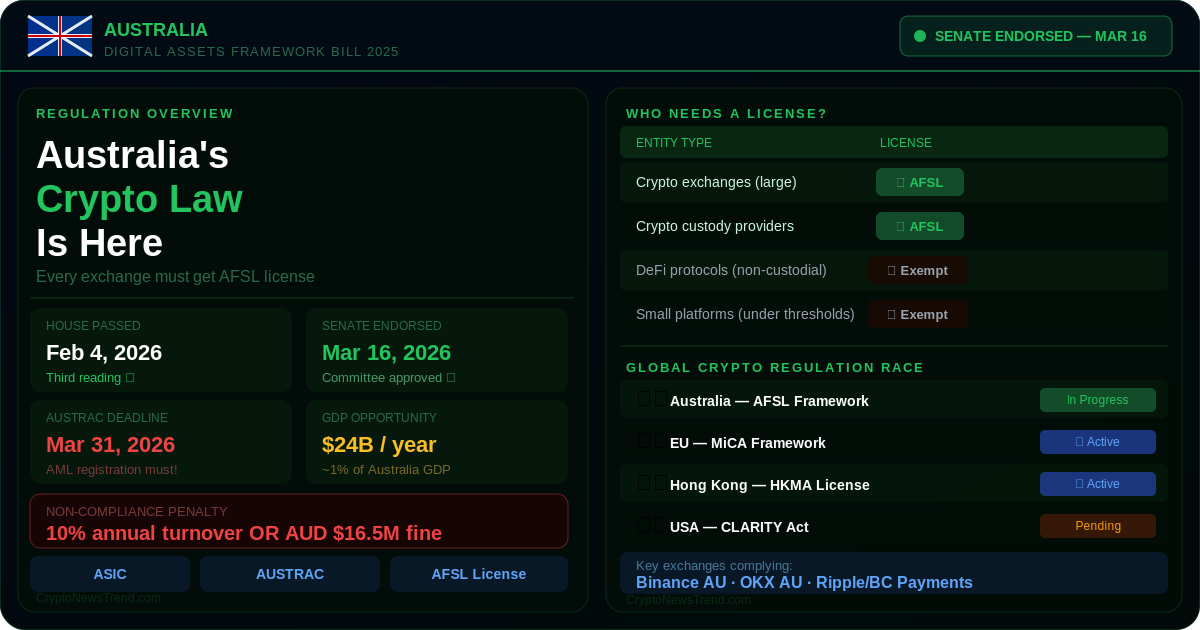
Australia Approves Crypto Licensing Framework Every Exchange Must Get AFSL License in 2026
Australia's Senate Economics Legislation Committee has endorsed
a bill that would bring cryptocurrency platforms and custody providers under the
country's existing financial services framework. The bill endorsed on
March 16, 2026 is one of the most comprehensive crypto regulatory
frameworks in the Asia-Pacific region, and analysts estimate it could unlock
up to $24 billion per year roughly 1% of Australia's GDP
in digital finance innovation.
The Bill at a Glance
| Detail | Data |
|---|---|
| Bill Name | Corporations Amendment (Digital Assets Framework) Bill 2025 |
| Senate Committee Endorsement | March 16, 2026 |
| House of Representatives Passed | February 4, 2026 |
| Regulator | ASIC (Australian Securities and Investments Commission) |
| AML Regulator | AUSTRAC |
| License Required | Australian Financial Services Licence (AFSL) |
| Transition Period | 6 months after Royal Assent |
| AUSTRAC Registration Deadline | March 31, 2026 |
| Maximum Penalty (Non-Compliance) | 10% of annual turnover or AUD $16.5 Million |
What Exactly Does This Law Regulate?
The proposed Corporations Amendment (Digital Assets Framework)
Bill 2025 would create a licensing and compliance regime for digital token managers
by amending the Corporations Act 2001 and the ASIC Act 2001. The framework targets
firms that hold digital assets on behalf of customers bringing them under existing
financial services rules instead of attempting to regulate the underlying blockchain
infrastructure.
The bill defines core legal concepts of "digital token,"
"digital asset platform," and "tokenised custody platform" and establishes
licensing, disclosure, and conduct obligations for issuers and operators of
these platforms.
Who Needs a License And Who Is Exempt?
| Entity | License Required? | Condition |
|---|---|---|
| Crypto exchanges (large) | ✅ Yes AFSL required | Holding client assets above thresholds |
| Crypto custody providers | ✅ Yes AFSL required | Tokenised custody = financial product |
| DeFi protocols (non-custodial) | ❌ No exempt | Does not hold client assets |
| Small platforms | ❌ Exempt | Under AUD $5,000/customer + $10M/year turnover |
| Blockchain infrastructure | ❌ Not regulated | Bill targets intermediaries only |
Why Did Australia Need This Law? The FTX and Celsius Factor
The collapses of FTX and Celsius loomed large in the debate.
Regulators identified a gap in existing law where intermediaries could hold billions
of dollars in client digital assets without the safeguards required in traditional
finance creating conditions for frozen withdrawals, insolvency proceedings,
commingling with provider funds, and undisclosed proprietary trading.
These collapses left thousands of Australians with limited legal recourse.
Australia vs Global Crypto Regulations How It Compares
| Jurisdiction | Framework | Approach | Status |
|---|---|---|---|
| 🇦🇺 Australia | Digital Assets Framework Bill 2025 | Fits crypto into existing AFSL system | 🟡 Senate endorsed Parliament vote pending |
| 🇪🇺 European Union | MiCA (Markets in Crypto-Assets) | Standalone crypto-specific regulation | ✅ In force since Dec 2024 |
| 🇺🇸 United States | CLARITY Act + FIT21 | SEC + CFTC joint oversight | 🟡 Senate negotiations ongoing |
| 🇭🇰 Hong Kong | Stablecoins Ordinance + VASP | Separate crypto licensing regime | ✅ Active first licenses March 2026 |
| 🇸🇬 Singapore | Payment Services Act | MAS licensing for crypto businesses | ✅ Active since 2020 |
Impact on Major Crypto Exchanges in Australia
Ripple is seeking an AFSL through a proposed acquisition of
BC Payments to operate within Australia's licensed framework. Binance has restored
AUD deposits and withdrawals for Australian users and said it is committed to local
compliance.
OKX Australia CEO Kate Cooper linked legislative clarity
to productivity gains, citing research estimating that digital finance innovation
could add up to $24 billion a year roughly 1% of GDP.
Key Compliance Timeline What Exchanges Must Do Now
| Deadline | Requirement | Regulator |
|---|---|---|
| March 31, 2026 | Register with AUSTRAC AML programs live | AUSTRAC |
| Until June 30, 2026 | ASIC "no-action" period actively working toward compliance | ASIC |
| 6 months after Royal Assent | Full AFSL license obtained or operations cease | ASIC |
| Post-compliance | Ongoing: trading rules, settlement, custody, fee disclosure | ASIC + AUSTRAC |
FAQ Australia Crypto Licensing Law 2026
What is the Australia Digital Assets Framework Bill 2025?
The Corporations Amendment (Digital Assets Framework) Bill 2025
classifies digital-asset platforms and tokenized custody services as financial products
under existing financial-services law. Most operators handling client tokens must obtain
an Australian Financial Services Licence, with a six-month transition after the rules
come into effect.
When was Australia's crypto bill endorsed?
Australia's Senate Economics Legislation Committee endorsed
the bill on March 16, 2026. The bill had already passed its third reading in the House
of Representatives on February 4, 2026.
Do all crypto exchanges in Australia need a license?
Not all. Small platforms handling less than AUD $5,000 per
customer and under $10 million in yearly transactions can qualify for an exemption.
DeFi protocols and blockchain infrastructure that do not hold client assets are also
exempt. Only intermediaries holding customer crypto assets require an AFSL.
What are the penalties for non-compliance?
Companies that ignore the rules could face penalties of up
to 10% of their annual turnover or as much as AUD $16.5 million the same level of
legal responsibility as banks.
How does Australia's approach differ from Europe's MiCA?
Rather than creating an entirely new standalone regime like
the EU's MiCA, Australia is routing crypto oversight through its existing AFSL system.
This could reduce lead time for implementation but requires platforms to meet the same
compliance standards as traditional financial service providers.