
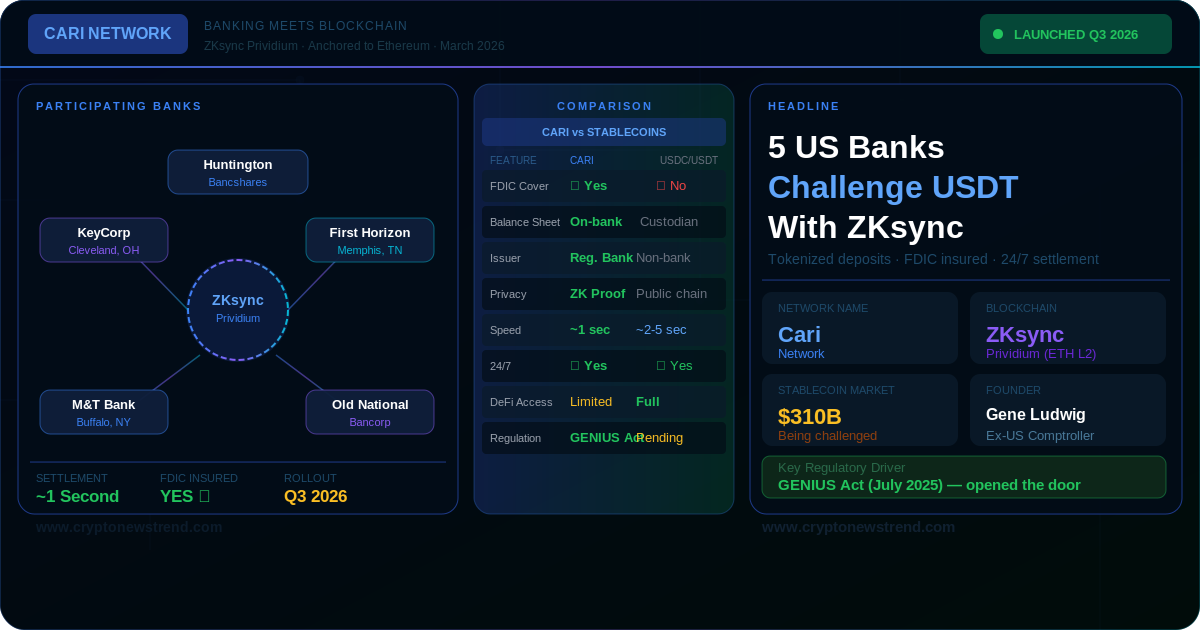
Five US Banks Launch Cari Network on ZKsync The Banking System's Answer to USDT and USDC
Five major US regional banks have launched a direct assault on
the private stablecoin market. The consortium unveiled the Cari Network a
blockchain-based payment rail built on ZKsync that enables instant settlement of
tokenized deposits without funds ever leaving the insured banking perimeter.
The network was announced Tuesday and is being developed with
banks including Huntington Bancshares, First Horizon, M&T Bank, KeyCorp and Old
National Bancorp, built on ZKsync and anchored to Ethereum.
The Cari Network at a Glance
| Detail | Value |
|---|---|
| Network Name | Cari Network |
| Blockchain Infrastructure | ZKsync Prividium (Matter Labs) anchored to Ethereum |
| Participating Banks | Huntington, First Horizon, M&T Bank, KeyCorp, Old National |
| Founded By | Gene Ludwig former US Comptroller of the Currency |
| Industry Backing | Mid-Size Bank Coalition of America |
| Testing Started | February 2026 |
| Full Rollout Target | Q3–Q4 2026 |
| Token Type | Tokenized deposits NOT stablecoins |
| FDIC Insurance | ✅ Yes remains on bank balance sheet |
| Settlement Speed | ~1 second (ZK finality) |
Tokenized Deposits vs Stablecoins The Critical Difference
The technical distinction is critical. Stablecoins are bearer
assets usually backed by treasuries in a custodial account. Tokenized deposits on the
Cari Network are digital representations of cash that sit directly on the bank's
balance sheet maintaining FDIC insurance eligibility and simplifying compliance
with stablecoin regulations.
| Feature | Cari Tokenized Deposits | USDC / USDT |
|---|---|---|
| Issuer | ✅ Regulated chartered bank | Non-bank company (Circle / Tether) |
| Balance Sheet | ✅ On-balance sheet bank liability | Off-balance sheet issuer custody |
| FDIC Insurance | ✅ Yes | ❌ No |
| Settlement Speed | ~1 second (ZK finality) | Seconds (Ethereum L2 / Solana) |
| Privacy | ✅ ZK proofs private execution | Public on-chain by default |
| Availability | 24/7 round the clock | 24/7 round the clock |
| Regulatory Access | ✅ Selective regulator audit | Public blockchain visibility |
| Interoperability | Within Cari permissioned network | Any DeFi protocol / public chain |
What Is ZKsync Prividium?
Prividium lets regulated institutions issue tokenized deposits
on private, enterprise-controlled chains delivering privacy, compliance,
programmability, and Ethereum-grade settlement. All execution is private,
with ZK proofs certifying correctness. Interoperability is built in
Prividium supports atomic DvP/PvP settlement and cross-chain liquidity.
ZKsync CEO Alex Gluchowski framed the platform as a way for
mid-sized banks to lead the infrastructure transition rather than be displaced.
"Financial infrastructure is being redesigned in real time, and mid-sized banks
are the ones being left behind," he stated.
Why Now? The GENIUS Act + Stablecoin Competition
For US bank executives, the era of regulatory ambiguity
regarding digital assets effectively ended in July 2025 when the GENIUS Act
established a federal framework for payment stablecoins. Combined with the
Rescission of SAB 121 and updated guidance from the OCC, FDIC, and Federal
Reserve, a new reality emerged. In 2026, the question is no longer if blockchain
will integrate with banking the question is how regional banks will protect
their deposit franchises against 24/7, programmable, global competitors.
Impact on USDT, USDC and the $310B Stablecoin Market
| Scenario | Impact on Stablecoins |
|---|---|
| Cari wins institutional B2B payments | 🔴 USDC/USDT lose corporate settlement volume |
| Cari stays within banking network only | 🟡 Neutral stablecoins retain DeFi/retail dominance |
| Banks expand to cross-border payments | 🔴 Tether's emerging market volume at risk |
| GENIUS Act favors bank-issued tokens | 🔴 Regulatory arbitrage shifts toward Cari model |
| Retail adoption remains with USDC/USDT | 🟢 Stablecoins retain peer-to-peer and DeFi layer |
Stablecoins will continue to play a role in retail and
crypto-native ecosystems useful for peer-to-peer transfers, developer platforms,
and public-chain applications where borderless access matters more than
balance-sheet integration. But for large-value, low-margin, system-scale flows,
tokenized deposits are emerging as the preferred on-chain dollar because they
look and behave like the instruments corporates already use.
FAQ Cari Network ZKsync 2026
What is the Cari Network?
The Cari Network is a permissioned Layer-2 blockchain platform
anchored to Ethereum using Prividium a ZKsync-based ZK rollup from Matter Labs
that enables digital assets representing customer deposits at chartered banks,
including FDIC insurance. It was founded by Gene Ludwig, former US Comptroller
of the Currency.
Which banks are in the Cari Network?
Participating banks include Huntington Bancshares, First
Horizon, M&T Bank, KeyCorp and Old National Bancorp. The Mid-Size Bank Coalition
of America has also backed the project.
How is Cari different from USDC or USDT?
Unlike USDT or USDC, Cari tokens remain liabilities of the
issuing bank, maintaining FDIC insurance eligibility and simplifying compliance
with stablecoin regulations. Stablecoins are bearer assets Cari tokens are
on-balance sheet bank money.
When will Cari Network launch?
Participating lenders including Huntington and KeyCorp are
targeting a Q3 2026 rollout to prevent deposit flight to faster
crypto-native alternatives, with full availability anticipated for Q4 2026.