
Autonomous Investing Raises Questions: Do Machines or Humans Hold the Reins to Your Wealth?
After $1.5 billion were taken from Bybit in February 2025, $286 million drained from Drift on April 1, 2026, and $292 million exited Kelp DAO seventeen days later the question that matters most about an AI trading agent today is not how smart its model is, but rather who holds the keys while it runs.
In each case, the cryptography was held. The human and infrastructure layers failed.
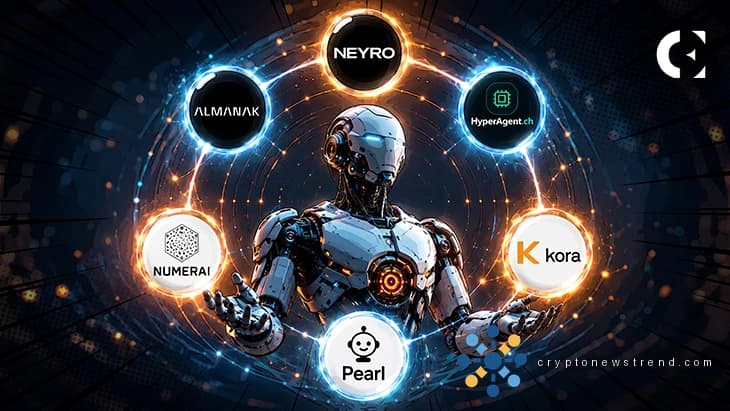
AI agents narrow the execution gap between institutional desks and retail traders through continuous monitoring, emotionless discipline, and faster rebalancing.They are capable of observe, reason, plan and strategically execute based on dynamic market data.This article discusses the following six AI-powered trading agents.
Non-custodial agentic trading with live data: Neyro
Crowdsourced ML hedge fund: Numerai
Regime-routed Hyperliquid perps: HyperAgent
Sentiment-driven Solana automation: Kora
Institutional-grade DeFi quant: Almanak
Autonomous prediction-market trading: Polystrat
Autonomous Crypto Trading Systems
1. Neyro: Non-custodial Agentic Trading
Neyro is a non-custodial AI agentic trading layer that executes through smart contracts on DEXes, including Hyperliquid. Funds remain in user-controlled wallets and no third party takes custody. Incorporated in British Columbia, Canada, the platform offers copy trading, leaderboards, user-defined risk limits, and a cancel-anytime subscription.
Its first live agent, Quantum Alpha, has been in closed beta with 100 users since January 2026, posting double-digit monthly returns in its first two 30-day windows and 31.4% in the most recent.
Pros
Cons
Non-custodial and no third party could ever take custody of the funds
Early-stage product; track record is still building
Live agent with published performance data
Currently in closed beta (100 users)
Cancel-anytime subscription — no lock-in
Bottom line: Non-custodial architecture, live performance data, and a retail-accessible model that doesn’t require DeFi expertise. The Phase 2 expansion to user-created agents will test whether that accessibility scales.
2. Numerai: The Crowdsourced Hedge Fund
Numerai runs a weekly tournament where roughly 30,000 data scientists submit obfuscated equity predictions, staking $NMR tokens against accuracy. A staked-weighted Meta Model trades a global long/short equity book. The fund manages $550 million in AUM, returned +25.45% net in 2024, and secured a $500 million capacity commitment from J.P. Morgan Asset Management.
The $30 million Series C closed at a $500 million valuation, led by university endowments. Retail traders can participate in the tournament but not the fund.
Pros
Cons
Longest track record and largest AUM in the category
Structured as a hedge fund with no direct retail access to the equity book
Institutional backing from J.P. Morgan Asset Management
$NMR token price is decoupled from fund performance
Transparent tournament mechanics with 30,000+ active participants
Bottom line: The most battle-tested AI-driven trading operation on this list — but it’s a hedge fund, not a consumer product. $NMR price is decoupled from fund performance.
3. HyperAgent: Regime-routed Perps Trading
HyperAgent classifies BTC into four macro regimes: trending, chopping, accumulation, distribution and routes execution through a dedicated alpha path for each as well as trading Hyperliquid perpetuals via trade-only API wallets with no withdrawal scope. A 7-signal consensus engine feeds into 17 pre-trade risk gates. Pricing starts at CHF 49/month with a 15-day free trial.
The technical documentation is detailed, and the team has been shipping regular updates including Gemini 3.0 Pro integration. The Swiss-registered company is a newer entrant that has not yet built a broad public profile.
Pros
Cons
Non-custodial trade-only API keys with no withdrawal access
Newer entrant with limited public visibility so far
Detailed regime-routing architecture
Team has not yet built a public profile
Active development with regular changelog updates
Bottom line: Technically interesting regime-classification approach with a solid non-custodial foundation. Worth tracking as the team builds public visibility.
4. Kora: Sentiment-driven Solana Automation
Kora, built by publicly listed Pioneer AI Foundry (Cboe Canada: JPEG), combines social-sentiment analysis with technical indicators (RSI, MACD, Bollinger Bands) across Solana markets. It offers two non-custodial modes: fully autonomous Autopilot and a natural-language Co-Pilot.
Kora is currently in private beta, taking a methodical approach to rollout. The public-company structure adds regulatory accountability that most crypto-native projects lack.
Pros
Cons
Publicly listed parent company with regulatory reporting obligations
Still in private beta — not yet publicly available
Non-custodial architecture
Solana-only coverage for now
Sentiment + technical hybrid approach is distinctive
Bottom line: The hybrid sentiment model and public-company transparency are distinctive. Worth watching as it moves toward a full commercial launch.
5. Almanak: Institutional-grade DeFi Quant
Almanak deploys an 18-agent “AI swarm” that researches, simulates, deploys, and risk-manages DeFi strategies inside multi-sig and TEE-secured vaults on Ethereum. It reported peak TVL of $132 million in December 2025 alongside over 100,000 users and roughly $6 million in annualized revenue. The ALMANAK token launched December 11, 2025 and is available on Bybit, Kraken, Gate, and MEXC.
On-chain TVL tracked by DefiLlama has fluctuated since, tracking broader market conditions. Strategies are simulated before deployment.
Pros
Cons
Non-custodial vaults secured by multi-sig plus Trusted Execution Environments
“Set strategy and let it run” model — not built for quick trades
Real revenue and a large disclosed user base
Post-TGE token volatility, as is common with new listings
Simulation-first approach reduces deployment risk
Bottom line: Serious infrastructure with a strong security posture. The simulation-before-deployment workflow is a meaningful differentiator for real capital.
6. Polystrat: Autonomous Prediction-market Trading
Polystrat, built on the Olas protocol and accessed via Pearl, runs autonomous Polymarket agents from a self-custodial Safe smart account on the user’s device. In its first month, agents executed over 4,200 trades with a peak single-trade return of 376%. Over 37% of Polystrat agents showed positive PnL versus roughly 16% of human Polymarket wallets.
New agent creation is temporarily paused due to Polymarket protocol updates, though existing agents continue to operate.
Pros
Cons
Strongest agent-vs.-human performance data in the category
Prediction markets only — no spot, perps, or yield
Fully self-custodial via Safe smart account
New agent creation temporarily paused (Polymarket protocol updates)
Independent verification via CoinDesk and on-chain analysis
Bottom line: The most compelling agent-vs.-human performance data in the category. Check back when new agent creation reopens.
To Conclude
Each of these six products is building toward AI-driven execution without sacrificing user control. They differ in maturity and market focus. The variable that will matter most in the next market cycle is the same one that defined the last three breaches: not what the agent can do, but what permissions it holds while doing it.