
Cryptocurrency's Largest Player Plummets Below Key Threshold, Paving Way for Monthly Decline
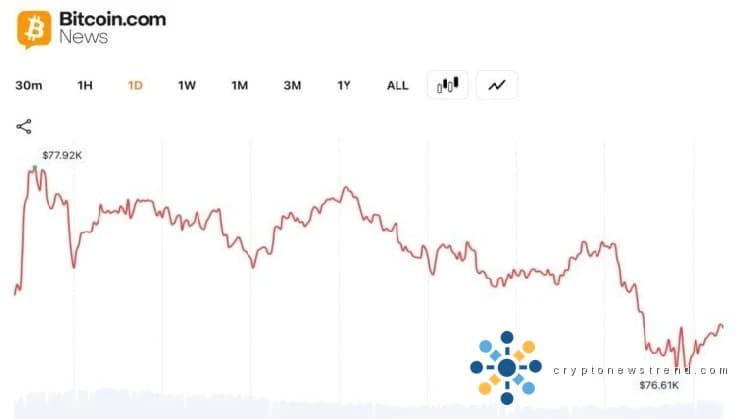
As the five-day workweek drew to a close, Bitcoin's prospects for a positive finish looked increasingly bleak, with the cryptocurrency succumbing to downward pressure and dipping below the $77,000 threshold on Friday. A sudden and intense sell-off, which saw Bitcoin's value plummet by nearly $1,000 in a mere two hours, sent the cryptocurrency crashing to an intraday low of $76,476, as reported by Bitstamp. Although it managed to recover somewhat, reaching $76,800 by 12:40 p.m. EST, the damage had already been done, setting the stage for a potentially dismal weekly close.
The day's events marked a stark reversal from the relatively stable price action observed on Thursday, when Bitcoin fluctuated between $77,200 and $78,000. However, the tranquility was short-lived, as a fresh wave of selling pressure emerged shortly after 9 a.m. on Friday, pushing the cryptocurrency into the red for the second consecutive day. This downturn not only extended Bitcoin's weekly losses to 3% but also shaved off a significant chunk of its market capitalization, which fell to $1.54 trillion from $1.55 trillion on May 21. The ripple effects of this decline were felt across the broader cryptocurrency market, causing the total market capitalization to contract to $2.65 trillion.
In a surprising divergence from traditional risk assets, Bitcoin's price movements appeared to decouple from the performance of global equities, which experienced a broad-based rally fueled by optimism surrounding potential diplomatic breakthroughs in the U.S.-Iran conflict. The easing of geopolitical tensions had a cascading effect on various asset classes, with crude oil prices sinking below $100 and $105 per barrel for WTI and Brent, respectively. This, in turn, helped to alleviate some of the upward pressure on bond yields, with the 10-year U.S. Treasury yield dipping to 4.55% after briefly testing 4.63% earlier in the week.
Against this complex backdrop, analysts at Bitunix offered a nuanced assessment of Bitcoin's evolving role within the cryptocurrency ecosystem. They suggested that the cryptocurrency is increasingly functioning as a real-time gauge of global liquidity conditions and investor confidence, rather than simply behaving as a traditional risk asset. According to their analysis, when bond markets begin to price in renewed rate hikes, while oil and gold prices rise in tandem, it may indicate a strengthening demand for defensive positioning, which could have a direct impact on capital flows into high-volatility assets like Bitcoin.
In a statement, the Bitunix analysts cautioned that the market's primary concern is no longer a single bearish catalyst, but rather the potential for a broader rotation of global capital away from growth-oriented assets toward defensive allocations. They warned that if U.S. Treasury yields continue to trend higher, Bitcoin's volatility could expand further, forcing markets to reassess the cryptocurrency sector's resilience in a prolonged high-rate environment.