
Digital payments titans envision blockchain backbone for future transactions, industry leaders reveal at major conference.
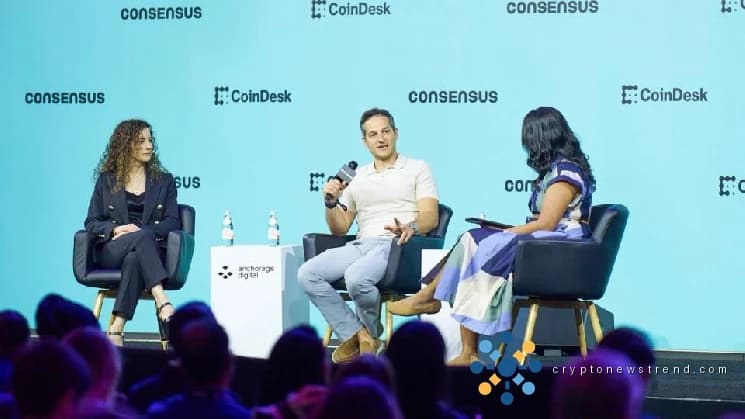
In a pivotal discussion at CoinDesk's Consensus Miami conference on Thursday, high-ranking executives from Google Cloud and PayPal shed light on the impending revolution in internet commerce, driven by the integration of cryptocurrency and artificial intelligence. According to Richard Widmann, Global Head of Web3 Strategy at Google Cloud, the current online experience is not conducive to autonomous agents, as they are unable to access traditional banking systems due to inherent technological and regulatory hurdles. On the other hand, cryptocurrency offers a seamless and machine-readable interface for transactions, making it an ideal solution.
To bridge this gap, Google Cloud has introduced the Agentic Payments Protocol (AP2), an open-source protocol that has been contributed to the FIDO Foundation, with over 120 partners, including PayPal, on board. This initiative is reminiscent of the x402 internet-native payment standard, which was donated to the Linux Foundation. Widmann emphasized the importance of open dialogue and standards in laying the foundation for future growth.
May Zabaneh, Senior Vice President and General Manager of Crypto at PayPal, echoed Widmann's sentiments, highlighting the company's efforts to adapt to the evolving landscape of commerce. She noted that PayPal is treating agents as the next major channel, following the company's transition from offline to online to mobile commerce. The company's stablecoin, PYUSD, is poised to play a crucial role in this shift, particularly as global commerce becomes increasingly intertwined with AI-driven experiences and tokenized assets.
A recent survey conducted by PayPal revealed that a staggering 95% of merchants are now witnessing AI agent traffic on their websites, yet only 20% have implemented machine-readable catalogs. Zabaneh stressed the need for merchants to prepare for this new era, drawing parallels with the transition from offline to online stores, where merchants must now expose their products in formats that are readable by agents.
The issue of liability also came to the forefront, with Zabaneh acknowledging that the industry must grapple with the question of responsibility in cases where an agent makes a problematic purchase. Widmann suggested that multi-party custody is becoming a critical component of agent design, with Google extending its Cloud KMS platform to support cryptocurrency custody. He proposed that agents should hold only a fragment of the private key, rather than the entirety, to prevent unilateral actions.
When asked about their concerns, Widmann cited the challenge of integrating agents into existing capital markets and infrastructure as a major hurdle. Zabaneh, on the other hand, expressed her professional concerns about trust, while personally, she is eager to experience the benefits of agentic technology in her daily life. The conference highlighted the significant strides being made in the intersection of cryptocurrency, AI, and commerce, with industry leaders like Google Cloud and PayPal at the forefront of this revolution.