
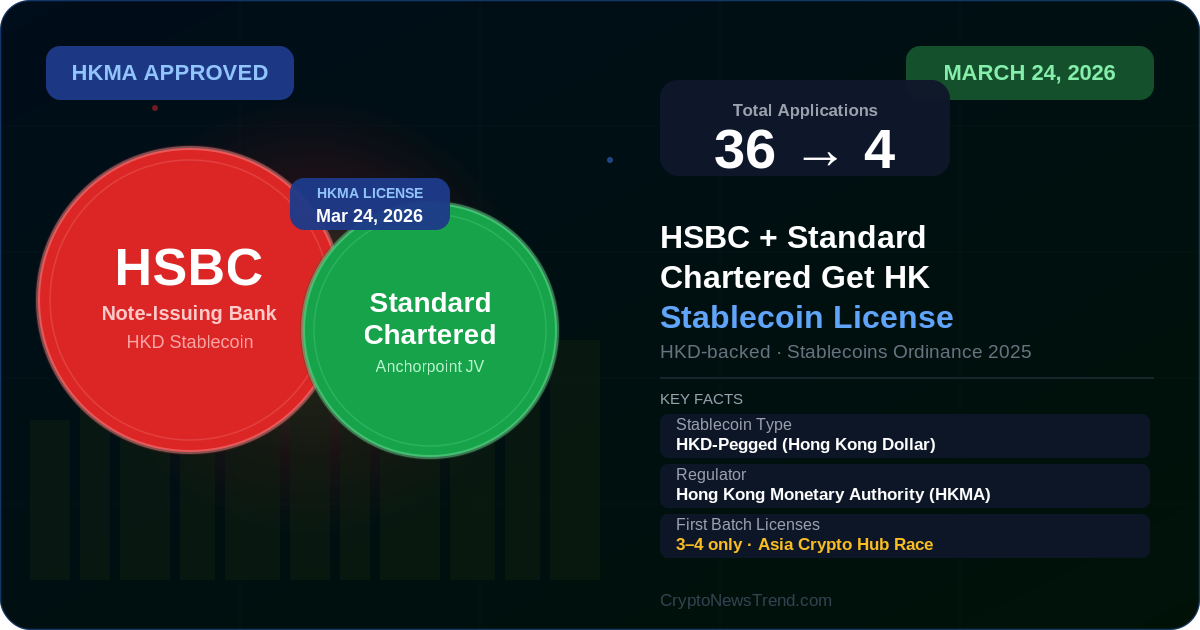
HSBC and Standard Chartered to Become Hong Kong's First Licensed Stablecoin Issuers
HSBC Holdings and Standard Chartered are set to be among
the first licensed stablecoin issuers in Hong Kong, giving two of the city's
note-issuing banks a central role in the government's effort to become a
digital-asset hub. Licenses could be issued as early as
March 24, 2026 — making this one of the most significant
institutional crypto milestones in Asia this year.
Key Facts at a Glance
| Detail | Data |
|---|---|
| Expected License Date | As early as March 24, 2026 |
| Regulator | Hong Kong Monetary Authority (HKMA) |
| Total Applications Received | 36 companies applied |
| First Batch Size | "Very small number" — 3 to 4 licenses max |
| Stablecoin Type | HKD-pegged (Hong Kong Dollar-backed) |
| Legal Basis | Stablecoin Ordinance (effective August 2025) |
| Other Likely Recipient | OSL Group (crypto-native firm) |
Why Did HKMA Choose Banks First?
In Hong Kong, the authority to issue banknotes is a privilege
held by only three commercial banks: HSBC, Standard Chartered, and the Bank of China.
The HKMA's decision to prioritize these institutions for stablecoin licenses is a
calculated effort to maintain monetary sovereignty. By utilizing banks that already
manage the city's physical money supply, the regulator ensures that the digital money
supply remains under the same rigorous oversight.
Standard Chartered: The More Prepared Bank
Standard Chartered has been particularly proactive.
Its joint venture with Animoca Brands and Hong Kong Telecom — operating as
Anchorpoint Financial — participated in the HKMA's stablecoin sandbox, testing
an HKD-backed stablecoin for e-commerce payments, cross-border transfers,
and tokenized asset trading.
Mary Huen, CEO of Standard Chartered in Hong Kong and
Greater China, stated the bank aims to become one of the first issuers of an
HKD-backed stablecoin, bringing an innovative medium of exchange securely
usable by institutions and individuals.
HSBC: The Surprise Frontrunner
The potential approval of HSBC, Hong Kong's largest bank
by assets, comes as a surprise given that it did not participate in the HKMA-led
stablecoin issuer sandbox, unlike its peer Standard Chartered. Despite
skipping the sandbox phase, HSBC has been actively engaging with crypto infrastructure
partners and is considered a leading candidate based purely on its size and systemic
importance to the city.
What Is the Stablecoin Ordinance?
In 2024, Hong Kong's Legislative Council established a measure
setting the stage for the city's stablecoin framework. The law went into force in
August 2025. Anyone in Hong Kong who issues fiat-pegged stablecoins — notably those
linked to the Hong Kong dollar — must obtain a license from the HKMA. Licensed
issuers must follow strict rules on reserves, disclosure, and redemption to keep
their tokens properly backed and redeemable at par.
Global Impact: What This Means for Crypto
| Impact Area | Effect |
|---|---|
| Asia Crypto Hub Race | 🟢 Hong Kong pulls ahead of Singapore and Japan |
| Institutional Stablecoins | 🟢 Banking-grade stablecoins enter mainstream |
| USDT / USDC Competition | 🟡 HKD stablecoin adds new fiat-backed competitor |
| Cross-border Payments | 🟢 HKD stablecoin speeds up Asia trade settlement |
| China's Crypto Stance | 🟡 HK moves ahead while mainland stays restricted |
FAQ
When will HSBC and Standard Chartered get stablecoin licenses?
Sources suggest a possible approval date of March 24, 2026,
though the number of licenses and timetable had yet to be finalised and remained
subject to change.
What kind of stablecoin will they issue?
Both banks are expected to issue Hong Kong dollar-pegged stablecoins.
Standard Chartered has already confirmed plans for an
HKD-backed stablecoin through its Anchorpoint joint venture with Animoca Brands
and Hong Kong Telecom.
How many stablecoin licenses will Hong Kong issue?
The HKMA received 36 formal applications under the
Stablecoins Ordinance. Financial Secretary Paul Chan confirmed that only a small
number of licenses would be granted in the first batch — likely 3 to 4.