
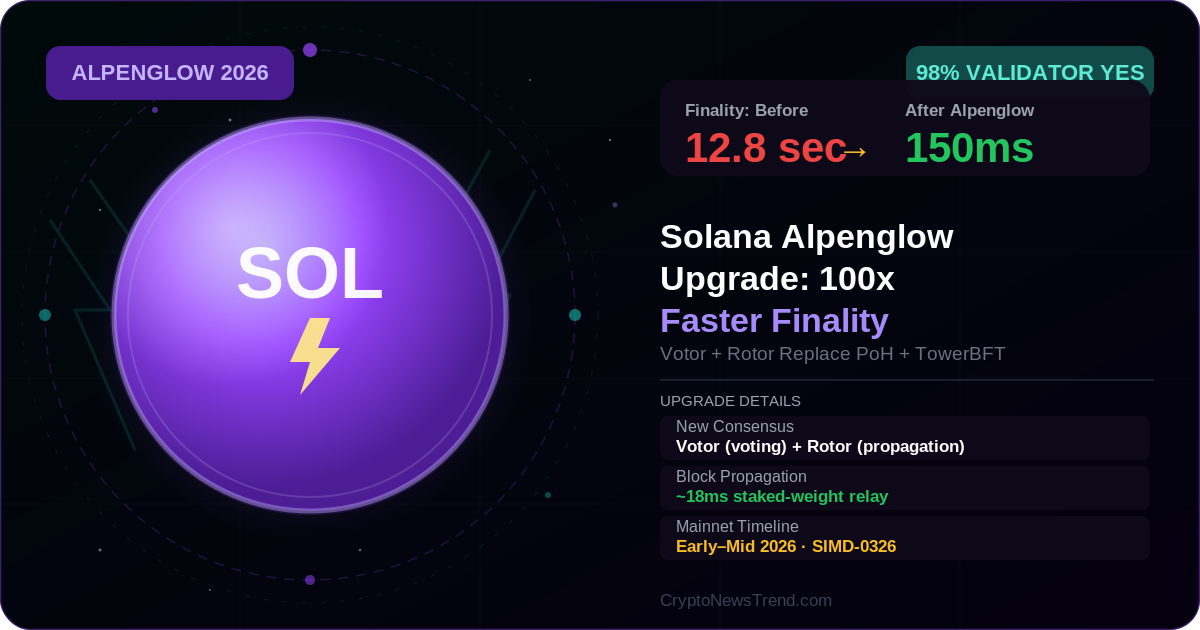
Solana Alpenglow: The Upgrade That Makes Solana 100x Faster — Everything You Need to Know
Solana is about to undergo its most significant technical transformation since launch.
The Alpenglow upgrade will reduce transaction finality from
the current 12.8 seconds to approximately 100–150 milliseconds — a reduction of
nearly 100x — marking a significant shift that would position Solana as one of
the fastest blockchain networks, outperforming legacy financial systems like Visa
and even average Google search response speeds.
Alpenglow at a Glance
| Detail | Before Alpenglow | After Alpenglow |
|---|---|---|
| Transaction Finality | 12.8 seconds | 100–150 milliseconds |
| Speed Improvement | ~100x faster | |
| Consensus Mechanism | Proof of History + Tower BFT | Votor + Rotor |
| Validator Vote Method | On-chain (costly, slow) | Off-chain aggregation (fast, cheap) |
| Block Propagation | Multi-hop relay (variable) | Staked-weight relay (~18ms) |
| Voting Fees | Paid per vote | Eliminated |
| Validator Approval | 98%+ validators voted YES (Sept 2025) |
What Are Votor and Rotor?
Votor — The New Consensus Engine
Votor replaces the incremental voting rounds of Tower BFT
with a lightweight voting aggregation model. Validators can aggregate votes off-chain
before submitting final confirmation, allowing blocks to be finalized within 1 to 2
confirmation rounds. If a proposed block receives over 80% of total staked weight
in the first round, fast confirmation is triggered immediately. If support is between
60% and 80%, a second round of voting is required to achieve finality.
Rotor — The New Block Propagation Layer
Rotor optimizes Solana's block propagation by using
staked-weight relay paths for efficient bandwidth use. Validators with high stake
and reliable bandwidth will serve as core relay points. Simulation data shows that
under typical bandwidth conditions, block propagation can be completed in as fast
as 18 milliseconds.
Why Did Solana Need This Upgrade?
Tower BFT requires 32 layers of voting to achieve finality.
Each layer doubles the commitment time, creating the 12.8-second delay. Meanwhile,
Proof of History generates a continuous cryptographic clock that validators must
verify, adding computational overhead to every operation. These were architectural
flaws — not parameter tuning issues — requiring a fundamental rethink of how
the network reaches consensus.
Alpenglow Mainnet Timeline
| Phase | Date | Status |
|---|---|---|
| Validator Governance Vote | September 2, 2025 | ✅ 98% approval |
| SIMD-0326 Proposal Submitted | Early 2026 | ✅ Submitted |
| Testnet Deployment | December 2025 | ✅ Completed |
| Security Audits | Q1 2026 | 🟡 In progress |
| Mainnet Launch | Early–Mid 2026 | 🟡 Approaching |
SOL Price and Alpenglow
Solana ETFs have pulled $1.45 billion in institutional
inflows even after a 57% drawdown from peak — a sign of conviction from smart money
about Solana's long-term trajectory. SOL is currently trading at around $84, with
Standard Chartered targeting $135 for year-end after cutting from $250.
FAQ
What is Solana Alpenglow?
Alpenglow is a major consensus upgrade for the Solana
blockchain that replaces Proof of History and Tower BFT with two new components —
Votor and Rotor — reducing transaction finality from 12.8 seconds to 100–150
milliseconds, a nearly 100x improvement.
When will Alpenglow launch on Solana mainnet?
The upgrade is expected to be rolled out between early and
mid-2026, pending final security audits and governance approval.
Does Alpenglow make Solana faster than Ethereum?
Yes — significantly. Ethereum's finality takes 12–15 minutes for full finality
(64 blocks). Alpenglow targets 100–150 milliseconds,
outperforming Ethereum, Avalanche, and most other major Layer 1 blockchains.