
Justin Sun Claims Trump Crypto Team Threatened to Burn Tokens
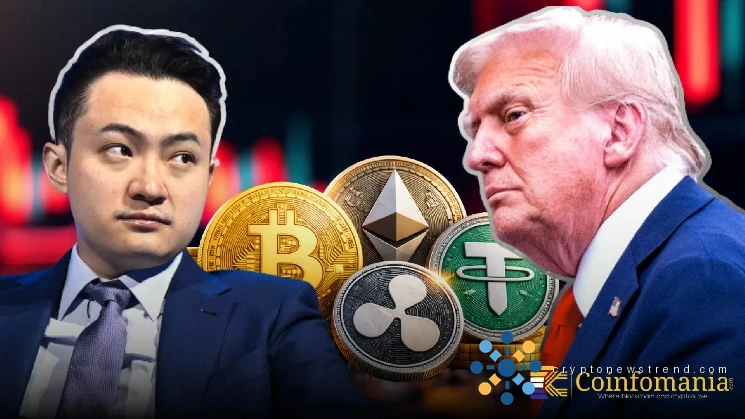
An increasing scandal of Justin Sun and World Liberty Financial is attracting considerable coverage in the crypto community. Sun is said to have filed a suit claiming that his $WLFI tokens holdings have been frozen, yet he was a significant stakeholder.
Tensions are rising at the intersection of crypto and politics.Justin Sun has alleged that associates tied to Donald Trump’s crypto venture, World Liberty Financial, threatened to burn his holdings of $WLFI tokens.According to claims in a lawsuit, the conflict reportedly began… pic.twitter.com/lsx3At9CbZ
— Favorite 💗 (@angelsharmin21) April 24, 2026
This situation got even worse when he states that his rights of governance were taken away, and even insiders threatened to burn down his tokens permanently. Considering the connections that the project is reported to have with Donald Trump, the conflict has both financial and political consequences.
What the Lawsuit Alleges
Several grave claims are in the lawsuit that bring up the issue of control in so-called decentralize regimes. Key accusations also include:
Cessation of transfer of token holdings in wallet of Sun.
Revocation of voting rights of governance.
Moreover, Sun asserts that he had a pressure to make additional investment in a related stablecoin, USD1. On proving, these activities would also put a question mark on the premise that users have every control of their properties in these ecosystems.
Governance Risk Understanding.
Also, in its essence, this case points to a more fundamental problem of crypto, in that governance is not as decentralized as it might seem. Although tokens are selling as a means of community control. The power can still be in concentration. Some of the key risks that are exposed are:
Concentration of tokens to allow insider control.
Centralization by a secret key or by multisig.
Low levels of transparency on governance decisions.
Theoretically, governance tokens give power to the users.
Justin Sun Politicking of Cryptocurrency Makes It Complicated
This conflict is even more important as it has political ties. The association of a project with Donald Trump is another point that brings additional scrutiny. Regulatory pressure and reputational risk are likely to be higher when politics and crypto collide. To investors, this scenario also outlines a key fact of great importance, ownership in crypto is not necessarily absolute. This poses some significant questions:
Are assets freezable in a self-custody?
Do token holders really govern?
Who decides in the protocol?
The difference between the perceived and the actual control is becoming more apparent.
A Change in Industry Risks
Remarkably, this case is a part of a larger transformation in crypto risks. The sector is shifting away of old fashioned smart contract exploits to governance-related fights.
The emphasis is changing to:
Access control mechanisms
Voting rights manipulation
Inside manipulation of protocols.
This is a new era where legal and structural risks can be just as significant as technical security. The case between Justin Sun and World Liberty Financial is not merely a court case but a manifestation of one of the biggest contradictions in crypto. The centralized control is oftentimes in conflict with the promise of decentralization. Governance is no longer optional to the users and investors. It is gaining importance just like the knowledge of price, utility and market trends.