
European Chipmaker ASML Gets Boost as UBS Names it Continent's Best Bet, Sees Price Soaring to Nearly €2,000
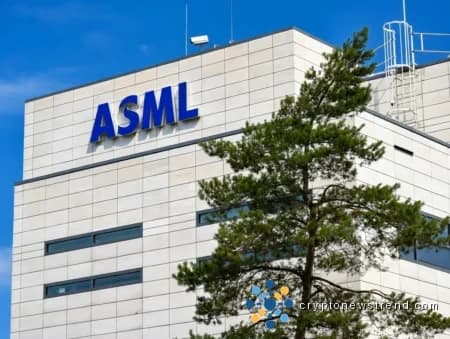
Table of Contents Shares of ASML experienced a 3.5% surge during Amsterdam trading hours on Tuesday after UBS elevated the Netherlands-based semiconductor equipment manufacturer to its top European sector recommendation and increased its price objective to €1,900 from the previous €1,600 target. ASML Holding N.V., ASML The upgrade accompanied an optimistic research report from UBS analyst Francois-Xavier Bouvignies, who characterized ASML as presenting the “most compelling risk/reward profile in the sector.” Despite its position as the globe’s leading chip equipment producer, ASML has underperformed relative to its industry counterparts this year. The company’s shares have appreciated approximately 40% year-to-date, trailing the 48% to 70% gains recorded by competitors such as Applied Materials, KLA, and Lam Research. UBS views this performance differential as a buying opportunity. The investment bank highlighted that ASML currently trades at merely a 6% premium to U.S. large-cap semiconductor equipment peers based on 12-month forward price-to-earnings multiples. Historically, its 10-year average premium stands at 84%. A central pillar of UBS’s investment thesis revolves around ASML’s significant presence in the memory chip equipment market. The firm characterized ASML as “the most memory-exposed semi-cap name,” projecting that roughly 30–35% of its revenues will derive from memory by 2026, surpassing the 25–30% exposure of U.S. competitors. This positioning has already yielded superior growth metrics. ASML achieved a 23% compound annual growth rate in memory-related revenue between 2020 and 2025, substantially outpacing the approximately 6% rate of its peers. UBS anticipates this trend will persist as DRAM technology node transitions drive heightened lithography equipment demand through 2028. UBS also dismissed concerns that ASML might emerge as a supply constraint for the semiconductor industry. The bank calculates that ASML’s 2027 production capacity can accommodate over 50% year-on-year expansion in cutting-edge wafer manufacturing output, significantly exceeding the projected 25–30% demand growth rate. Following its model adjustments, UBS now anticipates EPS of €48.42 in 2027 and €59.73 in 2028 — figures running roughly 15–20% above prevailing market consensus. Concurrently, ASML CEO Christophe Fouquet discussed the company’s advanced High-NA EUV technology at an industry gathering in Antwerp on Monday. Fouquet indicated that initial semiconductor products manufactured using High-NA systems should emerge within months, referencing customers in both memory and logic segments. “Those technologies are expensive. They are requiring qualification. But they are always designed with the idea that over time they will lower the cost of patterning,” Fouquet said. High-NA equipment units can reach prices approaching $400 million apiece. These systems enable the production of chip features measuring up to 66% smaller than those achievable with current technology. Intel has demonstrated the most assertive approach toward implementing these tools, while memory manufacturer SK Hynix has similarly committed to deploying the technology. TSMC, ASML’s principal customer, indicated last month that High-NA systems remain prohibitively expensive at present. TSMC executive Kevin Zhang explained the foundry will maintain its current EUV platform for multiple additional chip generations, relying on architectural innovations rather than reduced feature sizes to preserve competitiveness. UBS maintains that the business case for High-NA adoption remains compelling notwithstanding TSMC’s cautious stance. The bank estimates High-NA technology can deliver cost reductions of 20–40% on critical manufacturing layers compared to alternative patterning methodologies, and anticipates widespread industry adoption within two to three years. Fouquet further noted that the artificial intelligence revolution is projected to sustain approximately 20% annual growth in chip sales throughout upcoming years, and identified semiconductor manufacturers like TSMC and Samsung as the actual constraints on AI sector expansion — as these foundries must scale production capacity and procure additional ASML equipment to meet demand.