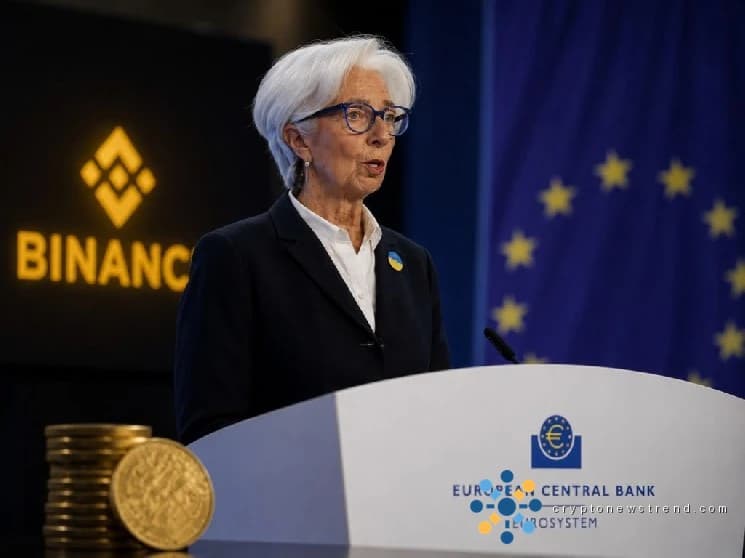

Binance’s application for a MiCA licence in Greece was denied after reports claim that European Central Bank President Christine Lagarde personally instructed the Greek authorities to block the crypto exchange’s entry into the EU market.
Alleged ECB Involvement
According to a story published by The Big Whale, journalist Gareth Jenkinson cited a reliable source who said the Hellenic Capital Market Commission initially approved Binance’s request as compliant with MiCA regulations. The source added that the ECB president later intervened, directing the Greek prime minister to reject the application.
Jenkinson reported that Lagarde’s message travelled through the Ministry of Finance before reaching the HCMC, effectively overturning the regulator’s earlier decision. The exchange’s bid to operate in Europe therefore stalled despite meeting the formal criteria.
Motives Linked to Stablecoins and the Digital Euro
Analysts suggest that the ECB’s move aims to limit Binance’s role as a major conduit for stablecoin liquidity across the continent. By sidelining the platform, policymakers may create room for the upcoming digital euro, a project the central bank has been developing.
Investors monitoring the crypto market view the development as a potential shift in the competitive landscape, with Binance’s exclusion possibly reshaping price dynamics for stablecoins and related assets.
Outlook for Binance and European Crypto Regulation
Binance’s leadership has not yet issued a formal response, while the European Union continues to refine its regulatory framework for digital assets. The episode underscores the growing tension between large crypto exchanges and policymakers seeking tighter oversight.
Future licensing decisions will likely hinge on how regulators balance innovation with concerns over market stability, a factor that investors will watch closely as the blockchain sector evolves.