
The Banks Would Like To Dye Your Stablecoins Pink
If you are a bank, your core business model is quite elegant. You take people’s money, you pay them zero percent interest on their checking accounts, and you lend that money out to other people at five or seven percent interest. You keep the difference. This is a very good business, and if you have it, you will fight very hard to keep it.
The problem with paying your depositors zero percent is that eventually, someone else will come along and offer to pay them something. When this happens, you have two choices. You can raise your own deposit rates to compete, which costs you money and ruins your business model. Or you can go to the government and ask them to make it illegal for the others to pay interest.
Historically, banks strongly prefer the second option.
A stablecoin is a cryptocurrency pegged to the US dollar. If you give a stablecoin issuer a dollar, they give you a digital token, put your dollar in Treasury bills, and earn about 4%. Historically, stablecoin issuers have kept that yield for themselves. The obvious next step in the evolution of this product is that they share some of the yield with you, so that you will hold their token instead of leaving your money parked elsewhere.
Under $GENIUS, issuers themselves cannot pay yield to holders. The live CLARITY fight is whether affiliated exchanges, distributors, or rewards programs can share those economics with users in ways that are functionally equivalent to interest.
The banks do not care for this.
And so they are calling their senators. Congress has been locked in talks for months over a crypto regulatory framework — the $GENIUS Act last summer for stablecoin issuers, and now the CLARITY Act for everything else, including the question of what stablecoin players can do. Treasury Secretary Scott Bessent has publicly urged the Senate to move forward:
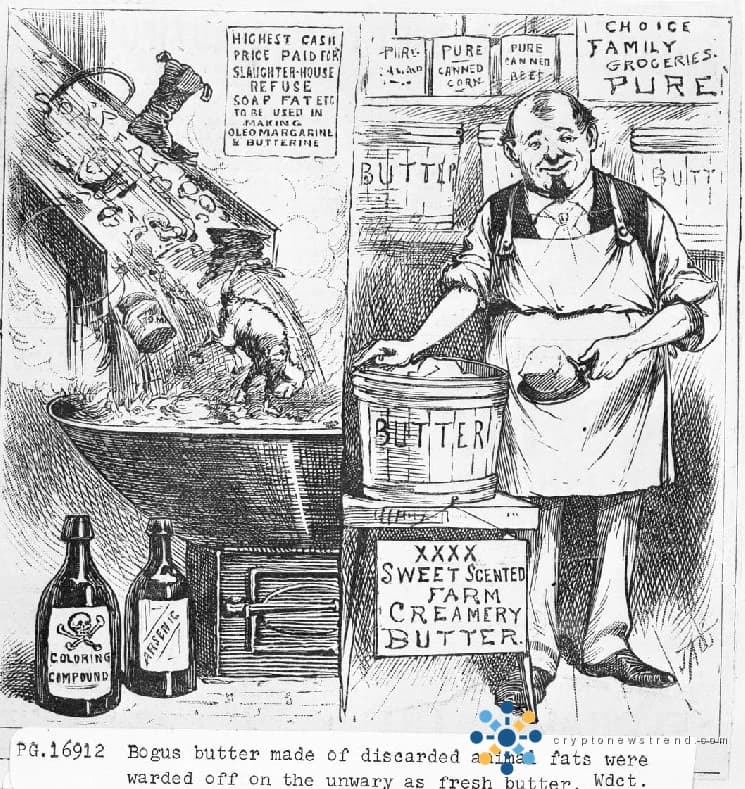
"Bogus butter" was the term used for oleomargarine.
Bettmann Archive
But the traditional banking lobby has demands first. According to Crypto In America reporter Eleanor Terrett, the North Carolina Bankers Association has been circulating a message, encouraging member banks to call lawmakers with this script:
“The CLARITY Act must include an airtight prohibition on payments for stablecoins acting as a store of value by clearly barring any interest or yield-like payments tied to the holding, retention, or balance of payment stablecoins — without carve-outs that can be met through nominal activity or loyalty programs.”
This is a masterpiece of the genre. What the banks are saying, in plain English, is: “We cannot stop stablecoins from existing, but you must legally mandate that they be worse than our products.” They want to ban anything "economically or functionally equivalent" to interest. We are the banks, we own the concept of interest, so you must stop the computer program.
It is also, as it turns out, a margarine law.
In 1869, a French chemist named Hippolyte Mège-Mouriès figured out how to make a cheap spreadable fat from beef tallow. Napoleon III wanted something to feed the army and the poor, and Mège-Mouriès gave him margarine. By the mid-1870s it had arrived in the United States, where it cost significantly less than butter and tasted, to an unaided palate, basically the same. This is the point at which the American dairy industry discovered that it could not compete on price or efficiency with a man who had invented butter in a factory, and so, like all industries that cannot compete on price or efficiency, it turned to the regulators.
By the turn of the century, more than thirty states had passed anti-margarine laws. The pitch was consumer protection: people could not be allowed to accidentally buy margarine while thinking it was butter.
Wisconsin farmers protest the usage and sale of 'synthetic butter,' otherwise known as oleo margarine which was made from vegetable or coconut oils, Madison, Wisconsin, circa 1930. (Photo by Underwood Archives/Getty Images)
Getty Images
The mechanism was, in retrospect, spectacular. New Hampshire and Vermont, among others, required margarine to be dyed pink. Not labeled pink. Dyed. The theory was that nobody will spread pink grease on bread, and therefore the product will be technically legal but commercially dead. This is an airtight prohibition without carve-outs that can be met through nominal activity. The Supreme Court struck down New Hampshire’s pink-margarine law in 1898, holding that it was “in necessary effect, prohibitory.”
So the states pivoted. They said: fine, you can sell margarine, but you cannot sell it yellow. Margarine is naturally white. Butter is yellow because cows eat grass. Without the color, the consumer will look at this tub of white grease and reject it. Commercially dead, but this time constitutional. The federal Margarine Act of 1886 added a two-cent-per-pound tax. The Grout Bill of 1902 raised it to ten cents per pound on yellow margarine while leaving uncolored margarine at a quarter of a cent.
Read the Grout Bill carefully. It does tax margarine — but it taxes margarine that resembles butter forty times more heavily. The regulated quantity is not just the product; it is the product’s resemblance to the incumbent product. Substitute “yellow” for “economically or functionally equivalent” and you are reading the March draft of the CLARITY Act.
The margarine industry did what industries do when regulators ban yellow. It shipped the product as a block of white margarine with a separate capsule of yellow dye. The consumer put the block in a bowl at home and worked the dye through with a wooden spoon. Generations of Americans spent the first half of the twentieth century sitting at their kitchen tables, performing a small act of civil disobedience every week to save thirty cents on butter. By the mid-1940s, Leo Peters had patented a plastic pouch with the dye capsule sealed inside, so consumers could pinch and knead the bag instead of mixing margarine in a bowl. This was considered a major innovation. If you are over a certain age, someone in your family may remember this.
Wisconsin kept its yellow-margarine restrictions until 1967, the last state to give up. Minnesota required public disclosure when oleomargarine was served in place of butter. Violations could carry criminal penalties. The point was not subtle: margarine could exist, but the law made restaurants announce the substitution.
Nobody was fooled. Everyone understood the point. The workaround became the product.
Eventually, World War II hit. Butter was heavily rationed, margarine was less so, and American households got so used to mixing the dye that they became much more comfortable substituting margarine for butter. Margarine outsold butter by 1958. The dairy lobby had spent eighty years successfully defending the legal definition of the word “butter,” and in the process had taught an entire country that you could mix your own yellow dye into a cheaper, longer-lasting, identically-functional spread and it would be fine. The carve-out became the industry. By the time Wisconsin gave up in 1967, margarine was not the substitute. It was the mass-market spread, and butter had become the luxury good.
In a strange coda, butter later won a different fight. By the 2000s, margarine’s trans-fat reputation had collapsed, and butter brands increasingly competed on provenance, fat content, and flavor — Irish grass-fed butter, European-style butterfat, cultured butter. The industry that had spent eighty years legislating against its substitute eventually won a different fight, the one no regulator had forced on it, which was to pay attention to what customers actually wanted.
This is the part where you may be nodding and assume the same thing will happen with stablecoins. Which it probably will. But there is a more recent and more financially precise version of this story, and it is even less flattering to the bank lobby, because the bank lobby is the one it happened to.
In 1933, the Banking Act prohibited banks from paying interest on demand deposits and gave the Fed authority to cap rates on savings deposits. This was Regulation Q. It was meant to prevent destructive rate competition and protect the community bank deposit franchise. It was airtight. It had no carve-outs. It was the closest financial ancestor of the regime the NCBA is currently asking Senator Tillis to enact for stablecoins.
In 1971, Bruce Bent and Henry Brown started the first money market mutual fund. It held short-term Treasuries and commercial paper. It passed the yield through to shareholders as “dividends,” because technically it was a 1940 Act registered fund and not a bank. It was functionally a checking account paying market rates, but formally it was a security, and Regulation Q regulated banks, not securities. In 1977 Merrill Lynch added check-writing and a Visa card and called it the Cash Management Account. By the early 1980s, money-market funds had become a $200-billion-plus industry. Today they hold more than $7.6 trillion. Deposit-rate ceilings were dismantled through the 1980s; the demand-deposit interest ban finally disappeared in 2011, seventy-eight years after the original prohibition.
The thing the banks wanted to protect in 1933 — their exclusive franchise over yield-bearing, dollar-denominated, liquid instruments — they lost to a wrapper that was technically not a bank. They did not lose it because of bad regulation. They lost it because the airtight prohibition trained an entire adjacent industry to build the same product in a form the prohibition did not cover.
So. Back to the NCBA sentence.
“Airtight prohibition” is a thing you can ask for. You will sometimes get it. The Oleomargarine Act of 1886 is an airtight prohibition. Regulation Q is an airtight prohibition.
What airtight prohibitions are very bad at is remaining about the thing they were written about. The margarine laws were about butter, until they were about teaching consumers that butter was optional. Regulation Q was about bank deposits, until it was about making money market funds a better savings vehicle for the American middle class. The prohibition works on the dimension the incumbent specified. The industry routes around that dimension. The resulting product is a version of the substitute specifically adapted to the contours of the prohibition. Which tends to make it better.
President Donald Trump signs the $GENIUS Act, a bill that regulates stablecoins, a type of cryptocurrency, in the East Room of the White House, Friday, July 18, 2025, in Washington. (AP Photo/Alex Brandon)
Copyright 2025 The Associated Press. All rights reserved
The CLARITY Act fight is about whether a crypto exchange can pay yield on a stablecoin balance. The banks want airtight. They want no carve-outs met through nominal activity. They want no exceptions for novel loyalty programs or business models. They want an economic equivalence standard strong enough to catch any structure that has the effect of interest, even if it is formally something else. This is, one should grant, a coherent request. It is what a lawyer who understood everything about how margarine beat butter, and everything about how money market funds beat banks, would ask for. It is the prohibition you would draft if you had read the history.
And the reason it will not work is that the airtight prohibition is often the cause of the substitution. It is not the defense against it. The dairy industry did not lose to margarine despite the yellow-dye laws. It lost to margarine because of them. The laws created a product category — mix-your-own margarine — that consumers engaged with at their kitchen tables for fifty years. Regulation Q did not fail to protect banks from money market funds. Regulation Q was the reason money market funds existed in that form.
If the CLARITY Act passes with an airtight prohibition on anything economically equivalent to interest, the stablecoin industry will spend the next decade designing products that are formally something else. They will hand users a white stablecoin and a digital packet of yellow dye and let them mix the yield in at home — which is to say, they will build products specifically adapted to the contours of whatever the government agencies will jointly write in their rulemaking. And at the end of the decade, the bank deposit franchise will discover it has been competing not with stablecoin yield, which is easy to regulate, but with whatever the industry built instead.
A customer enters a Blockbuster store in Dallas, Texas, U.S., on Wednesday, Dec. 4, 2013. Blockbuster announced at the beginning of November that it would be closing all stores as well as ending domestic retail and DVD by mail services. Photographer: Mike Fuentes/Bloomberg
© 2013 Bloomberg Finance LP
The deeper problem for the banks is that yield is not a side feature they’re defending. Their profit depends on paying depositors zero and earning five, and stablecoins-that-share-yield is specifically the product that breaks that model. This is Blockbuster and Netflix. In 2000, Blockbuster collected $800 million in late fees, which was sixteen percent of its revenue. The company was profitable because it was annoying. The famous story is that Reed Hastings started Netflix because Blockbuster charged him $40 for returning Apollo 13 late; Marc Randolph, his co-founder, has since admitted they made that up because it was the easiest way to explain the subscription model to the press. Which is fine. The story worked because everyone instantly understood what Netflix was selling. They were selling not-Blockbuster. That same year, Blockbuster had the chance to buy Netflix for $50 million and laughed them out of the room. In 2005, it tried to scrap late fees to compete. It could not figure out how to make money without them. It brought them back under a different name and filed for bankruptcy in 2010. The airtight prohibition is the version of that story where Blockbuster gets Congress to ban flat-rate subscriptions. Which is, in effect, what the banks are asking for.
NEW YORK - MARCH 17: People stand inside the offices of JP Morgan Chase on March 17, 2008 in New York City. (Photo by Michael Nagle/Getty Images)
Getty Images
Not every bank is Blockbuster. The smart response to better rails is to use the better rails. JPMorgan has done exactly that: its deposit token JPMD — which can pay interest because it is a bank deposit rather than a stablecoin — launched on a public blockchain last year. Multiple banks are running similar tokenized-deposit products on their own private blockchains, which is a permutation of the same bet. The largest banks are not sitting this one out. They are building the product the NCBA wants Congress to ban. Which suggests the lobbying is less a strategy than a delay tactic — one that won’t save the banks running it, because the loudest banks in the lobbying fight may not be the banks best positioned to compete.
The White House Council of Economic Advisers published a paper two weeks ago arguing that a complete ban on stablecoin yield would increase aggregate bank lending by $2.1 billion — 0.02 percent of total loans. The American Bankers Association rebutted this by saying the CEA had studied the wrong question. On this one narrow point, the ABA is right. The CEA studied the current-scale lending effect of a prohibition. The relevant question is what happens in year twenty. The relevant comparison is not money market funds in 1972. It is money market funds in 2011.
The banks are welcome to get the airtight prohibition they are asking for. They should probably be careful what they ask for. The last time they asked for one, they got Vanguard. The time before that, somebody got Wisconsin.