
Ripple's price stabilization at key threshold sparks attention on constrained market fluctuations.
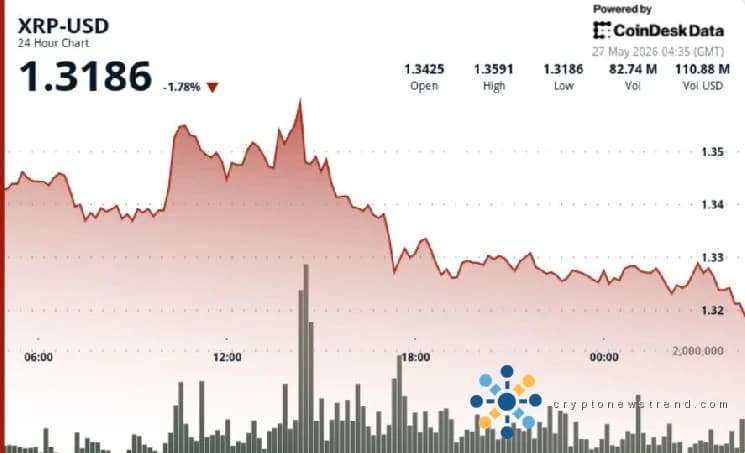
The XRP token has been oscillating within a narrow range for months, with the recent unsuccessful attempt to breach the $1.36 mark serving as a stark reminder of the challenges buyers face in sustaining upward momentum. Despite the ongoing compression beneath the resistance level, the absence of intense selling pressure below $1.30 indicates that major holders are not entirely relinquishing their positions.
In the broader cryptocurrency market, sentiment took a downturn, with fear-driven trading strategies reaching a three-week high. Meanwhile, on-chain data revealed that XRP continues to flow out of major exchanges, a trend that some traders interpret as a sign of long-term accumulation rather than active selling.
Analysts have been highlighting a large symmetrical triangle pattern that has been constraining XRP's price movement since early 2025. On May 27, the token's price fluctuated between $1.3039 and $1.3429, ultimately settling near $1.32. A notable spike in volume occurred during the failed breakout attempt near $1.36, with over 62 million XRP changing hands before the price retreated.
From a technical standpoint, XRP remains trapped within a narrowing consolidation range of approximately $1.30 to $1.38. The repeated failures to surpass $1.36 have solidified this area as the primary resistance zone. Short-term momentum appears weak, as the price has failed to reclaim broken support levels near $1.337. Nevertheless, the support level at $1.30 continues to hold, despite multiple tests, thereby maintaining the broader compression structure.
Traders should keep a close eye on the $1.30 support floor, as a breach of this level could shift the focus towards deeper downside targets in the mid-$1.20 range. Conversely, a breakout above the $1.36-$1.38 zone is essential for XRP to gain meaningful momentum. As the range continues to tighten, the likelihood of a sharp increase in volatility upon a eventual breakout from the consolidation phase grows.